Psalm 23 is the most recognized passage in the entire Bible. It has been whispered at bedsides, recited at funerals, memorized by children, and clung to by the suffering. In just six verses, it paints a portrait of God so intimate, so tender, and so complete that it has comforted every generation of believers for three thousand years.
Yet for all its familiarity, Psalm 23 is often read too quickly. We know the words so well that we can recite them without ever truly hearing them. "The Lord is my shepherd" becomes a pleasant phrase rather than a life-altering declaration. "I shall not want" becomes a line in a poem rather than a radical statement of trust.
This psalm was never meant to be skimmed. It was meant to be meditated on, slowly, verse by verse, until every word sinks from your mind into the deepest places of your heart. When you truly meditate on Psalm 23, something remarkable happens. The Shepherd stops being a metaphor and becomes a presence. The green pastures stop being imagery and become the place where you actually find rest.
This guide will walk you through every verse of Psalm 23 with practical meditation exercises designed to help you not just understand the Shepherd's Psalm, but to experience the Shepherd Himself.
Background: Understanding Psalm 23
Psalm 23 was written by David, the shepherd boy who became king of Israel. This matters deeply. David did not write about shepherding as a distant metaphor. He had spent years in the Judean wilderness tending his father's sheep. He had led them to water. He had guided them through narrow, dangerous valleys. He had fought off lions and bears with his own hands to protect them.
When David wrote "The Lord is my shepherd," he was drawing on the most formative experience of his life. He knew exactly what a good shepherd does because he had been one. And he recognized that everything he had done for his sheep, God was doing for him on a scale beyond comprehension.
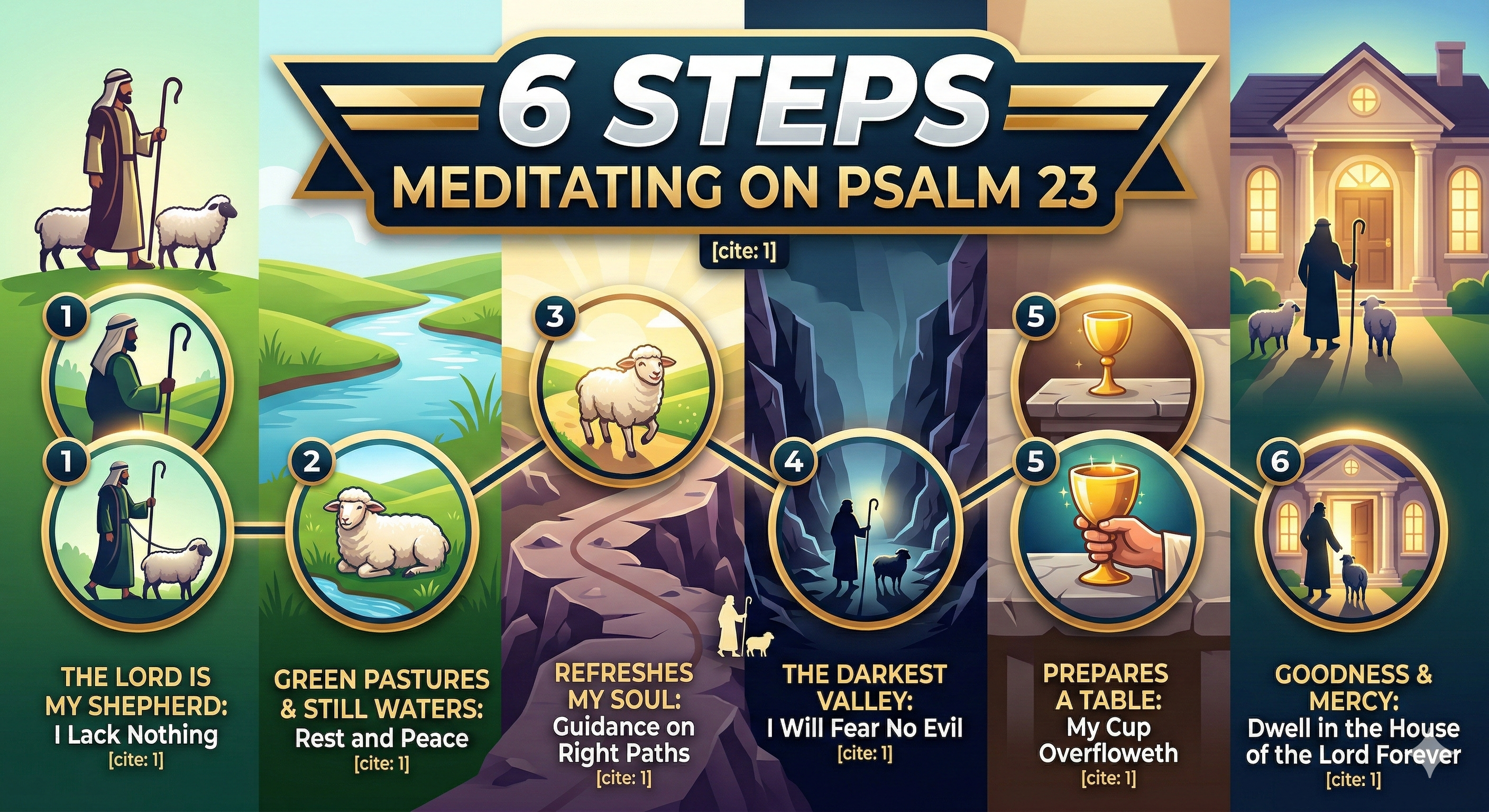
The psalm has a beautiful structure that mirrors the journey of a sheep through a single day with its shepherd. It begins in green pastures and beside still waters (morning grazing). It moves through a dark valley (the dangerous midday journey between pastures). It arrives at a table of abundance and an overflowing cup (the evening provision). And it ends with a declaration of eternal belonging: "I will dwell in the house of the Lord forever."
This is not just a poem. It is a day in the life of someone who belongs to God. And as you meditate on it, you are invited to live that day yourself.
Verse 1: "The Lord Is My Shepherd, I Lack Nothing."
The entire psalm rests on this single verse. Everything that follows -- the green pastures, the still waters, the protection through the valley, the overflowing cup -- all of it flows from this one declaration: the Lord is my shepherd.
In the ancient Near East, a shepherd was not a hired hand. A shepherd was an owner, a provider, a protector, and a guide. The sheep belonged to the shepherd, and the shepherd's entire life was organized around the well-being of the flock. A good shepherd knew each sheep by name. He slept at the entrance of the pen to guard them at night. He went ahead of them to find safe pastures and clean water. He carried the weak ones on his shoulders.
When David says "The Lord is my shepherd," he is saying: God knows me by name. God's life is organized around my well-being. God goes ahead of me. God guards me while I sleep. God carries me when I am weak.
And then comes the consequence: "I lack nothing." Not "I have everything I want." Not "Life is easy." But "I lack nothing." The distinction is profound. A sheep following a good shepherd may walk through difficult terrain. It may face storms. But it will never lack what it truly needs, because the shepherd's job is to provide. If the Lord is your shepherd, then whatever you truly need, you have -- or you will have it at the moment you need it.
Meditation Exercise
Sit quietly and read verse 1 aloud five times, slowly. Each time, place gentle emphasis on a different word. First: "The Lord is my shepherd." Second: "The Lord is my shepherd." Third: "The Lord is my shepherd." Fourth: "I lack nothing." Fifth: "I lack nothing." After the fifth reading, close your eyes. Picture a shepherd walking ahead of you on a path. He knows where he is going. He knows what you need. Tell him: "You are my shepherd. I trust You to provide." Sit in that trust for three minutes.
Verses 2-3: Green Pastures, Still Waters, a Restored Soul
Notice the verbs: He makes me lie down. He leads me. He refreshes. He guides. Every action belongs to the shepherd. The sheep does not find the green pasture on its own. The sheep does not navigate to still water by its own instincts. The shepherd does all of this. Your role is not to figure everything out. Your role is to follow.
The detail "He makes me lie down" is especially significant. Sheep do not lie down easily. A sheep will only rest when it feels completely safe -- free from fear of predators, free from conflict with other sheep, free from hunger and irritation. A shepherd who makes his sheep lie down has addressed every source of anxiety. He has created an environment of total peace.
The "quiet waters" (or "still waters") carry another layer of meaning. Sheep are afraid of fast-moving water. They instinctively know that their wool, when waterlogged, can drag them under. A good shepherd never drives sheep to a rushing river. He finds calm pools, gentle streams, places where the sheep can drink without fear. God does not overwhelm you. He leads you to places where you can receive what you need without anxiety.
"He refreshes my soul" is sometimes translated "He restores my soul." The Hebrew word is shub -- to return, to bring back. It is the image of a sheep that has wandered being gently brought back to the flock. God does not scold you for wandering. He restores you. He brings your soul back to wholeness, back to peace, back to Himself.
And He does all of this "for his name's sake." Not because you earned it. Not because you were good enough. But because He is who He is. His reputation as a good shepherd depends on the well-being of His sheep. Your restoration brings glory to His name.
Meditation Exercise
Read verses 2-3 and then close your eyes. Picture the greenest, most peaceful meadow you can imagine. A gentle stream runs through it. The air is warm and calm. The shepherd has brought you here. He is inviting you to stop striving, stop worrying, and simply lie down. Where in your life do you need to stop striving? What anxiety is keeping you from resting? Name it silently. Then picture the shepherd gently taking that burden from you and setting it aside. Breathe deeply and say: "He makes me lie down. He leads me beside quiet waters. He restores my soul." Stay in this place for five minutes.
Verse 4: Through the Valley of the Shadow of Death
This is the center of the psalm, and it marks a dramatic shift. The language changes from third person ("He leads me") to second person ("You are with me"). In the green pastures, David speaks about his shepherd. In the valley, David speaks directly to his shepherd. Suffering has a way of making God's presence more personal, not less.
The "darkest valley" -- traditionally translated "the valley of the shadow of death" -- refers to the deep, narrow ravines in the Judean wilderness that shepherds had to lead their flocks through to reach new pastures. These ravines were dangerous. The walls were steep. Predators could lurk above. The shadows were so deep that even at midday, the valley floor was dark. But the only way to reach fresh grazing land was through these valleys. There was no way around them.
David does not say, "I will not walk through the darkest valley." He says, "Even though I walk through it." The Christian life does not promise an absence of dark valleys. It promises a presence in them. You will face grief. You will face loss. You will face seasons so dark that you cannot see the next step. But you will walk through them. Not into them permanently. Through them. And you will not walk alone.
"I will fear no evil" is not a feeling. It is a decision rooted in a fact: "for You are with me." Fear loses its power not when circumstances change but when you become aware of who is with you in those circumstances.
The "rod and staff" served dual purposes. The rod was a short, heavy club used to fight off predators. The staff was a long, hooked stick used to guide sheep and pull them out of danger. One is for protection. The other is for guidance. And David says both "comfort" him. The Hebrew word for comfort here, nacham, means to breathe deeply, to sigh with relief. In the darkest valley, the shepherd's tools of protection and guidance allow David to exhale.
Meditation Exercise
If you are walking through a dark valley right now -- grief, illness, uncertainty, fear -- this verse is for you. Read it aloud slowly three times. Then speak directly to God, as David does: "You are with me." Say it again. "You are with me." Now picture the shepherd walking beside you in the specific valley you are facing. He has his rod in one hand and his staff in the other. He is not anxious. He is not surprised by this valley. He has walked this path before. He knows the way through. Sit with His presence for as long as you need. There is no hurry. The shepherd sets the pace.
Verse 5: A Table in the Presence of Enemies
The imagery shifts here from shepherd and sheep to host and honored guest. In ancient Near Eastern culture, hospitality was sacred. To prepare a table for someone was an act of honor, protection, and lavish generosity. And to do so "in the presence of enemies" was a deliberate statement: this person is under my protection, and no one will touch them.
There is something almost defiant about this verse. God does not merely rescue you from your enemies. He seats you at a banquet table right in front of them. While they watch, He honors you. While they look on, He anoints your head with oil -- a sign of joy, blessing, and being chosen. While they stand powerless, your cup overflows with abundance.
The anointing with oil also has a shepherding context. Shepherds would anoint their sheep's heads with oil to heal wounds, repel insects, and soothe irritation. It was an act of tender, individual care. God does not just provide for you in general. He attends to your specific wounds. He soothes your specific irritations. He treats you with individual attention and care.
"My cup overflows" is the language of more than enough. Not just sufficient. Not just adequate. Overflowing. God's provision is not stingy. When He gives, He gives abundantly, pressed down, shaken together, and running over. The cup overflows not because you earned it but because that is the nature of your host. He is generous beyond measure.
Meditation Exercise
Read verse 5 and consider: what are the "enemies" in your life right now? They may be external circumstances, internal struggles, persistent fears, or difficult people. Name them honestly. Now picture God preparing a table for you -- not in a safe, hidden place, but right where those enemies can see. He pulls out your chair. He serves you. He anoints your head with oil. He fills your cup until it overflows. You are His honored guest, and nothing your enemies do can change that. Sit at this table. Receive what He is offering. Say: "You prepare a table for me. My cup overflows." Let the abundance of God's provision wash over the anxiety of your enemies' presence.
Verse 6: Goodness, Love, and an Eternal Home
The psalm ends not with a prayer or a request but with a declaration of absolute confidence. "Surely" -- there is no doubt in David's voice. This is certainty born from experience. David has been through the green pastures and the dark valleys. He has sat at the table of abundance. And now he looks back over the whole journey and sees a pattern: goodness and love have been following him the entire time.
The word "follow" in Hebrew is radaph, and it is a surprisingly intense word. It means to pursue, to chase, to run after. It is the same word used for a hunter pursuing prey or an army pursuing a fleeing enemy. David is saying that God's goodness and love are not passive qualities that happen to be nearby. They are actively chasing him. They are relentlessly pursuing him. Wherever he goes, they follow. He cannot outrun them.
This transforms the entire psalm. You are not just a sheep following a shepherd. You are a beloved child being pursued by goodness and love. Even when you wander. Even when you stumble. Even when you walk through the darkest valley and cannot feel anything at all -- goodness and love are right behind you, chasing you down.
"I will dwell in the house of the Lord forever." The psalm began with the sheep in a pasture and ends with the sheep at home. The journey was never aimless. The shepherd was always leading somewhere. And the destination is not a place. It is a presence. To dwell in the house of the Lord is to be permanently, irrevocably, eternally at home with God. This is the final promise: no matter what valleys lie ahead, the last chapter of your story is already written. You will dwell with Him forever.
Meditation Exercise
Read verse 6 aloud. Then look back over the past year, the past month, or even the past week. Where can you see God's goodness and love pursuing you? It may be in small mercies: a conversation that came at the right moment, a peace that arrived when you did not expect it, a provision you did not plan for. Name three specific instances of God's goodness pursuing you. Thank Him for each one by name. Then read the final line: "I will dwell in the house of the Lord forever." Let the permanence of that promise settle over you. You belong to Him. You are going home. And nothing -- not death, not suffering, not the darkest valley -- can change your destination.
How to Make Psalm 23 a Daily Practice
Psalm 23 is short enough to read every day and deep enough to sustain a lifetime of meditation. Here are practical ways to weave this psalm into your daily rhythm.
Morning Surrender
Read Psalm 23 aloud each morning before you check your phone, read the news, or begin your tasks. Let it be the first voice you hear. As you read verse 1, consciously surrender your day to the Shepherd. Tell Him: "You are my shepherd today. I trust You to lead me wherever I need to go." This takes less than two minutes, but it reorients your entire day around trust rather than anxiety.
Evening Reflection
Before bed, read Psalm 23 one more time. But this time, read it as a reflection on the day you just lived. Where did you experience green pastures? Where did you walk through a dark valley? Where did God prepare a table for you? End with verse 6 and thank God for the goodness and love that pursued you throughout the day, even in the moments you did not notice.
Memorize the Psalm
Psalm 23 is only six verses. Most people can memorize it in a single week by learning one verse per day and reviewing the previous verses each morning. Once it is in your heart, it becomes available to you in every situation -- in the waiting room, in the sleepless night, in the moment of fear. Memorized Scripture is Scripture that the Holy Spirit can activate at exactly the moment you need it.
Guided Meditation with the Faith App
If you want to go deeper with Psalm 23 meditation, the Faith: Scripture Meditation app offers guided meditation sessions that walk you through passages like Psalm 23 with calming audio, gentle prompts, and space for reflection. It is a wonderful companion for those who find it difficult to quiet their mind on their own. The app helps you move from reading Scripture to truly dwelling in it.
Psalm 23 is not a poem to be admired from a distance. It is an invitation to be accepted. The Shepherd is not a character in a story. He is a living God who is speaking to you right now, calling you by name, and inviting you to follow Him into green pastures, through dark valleys, and all the way home. The question is not whether He is your shepherd. The question is whether you will let Him lead.
Conclusion
There is a reason Psalm 23 has endured for three millennia. It is not because the poetry is beautiful, though it is. It is not because the imagery is vivid, though it is. It is because the God it describes is real, and the relationship it offers is available to every person who reads it.
David wrote these words not from a place of comfort but from a life of extraordinary hardship. He was hunted by a king who wanted to kill him. He spent years hiding in caves and deserts. He experienced betrayal, loss, and the consequences of his own failures. And yet he could say with absolute confidence: "The Lord is my shepherd. I lack nothing."
That same shepherd is available to you today. He is not too busy. He is not indifferent. He knows your name. He knows what valley you are walking through. He knows what fears keep you awake at night. And He is inviting you, right now, to stop striving, to stop worrying, and to follow Him.
Begin meditating on Psalm 23 today. Do not rush through it. Take one verse at a time. Do the meditation exercises. Sit in silence and let the Shepherd speak. You may be surprised to discover that the God of Psalm 23 is not distant at all. He has been pursuing you with goodness and love your entire life. And He will not stop until you are safely home.