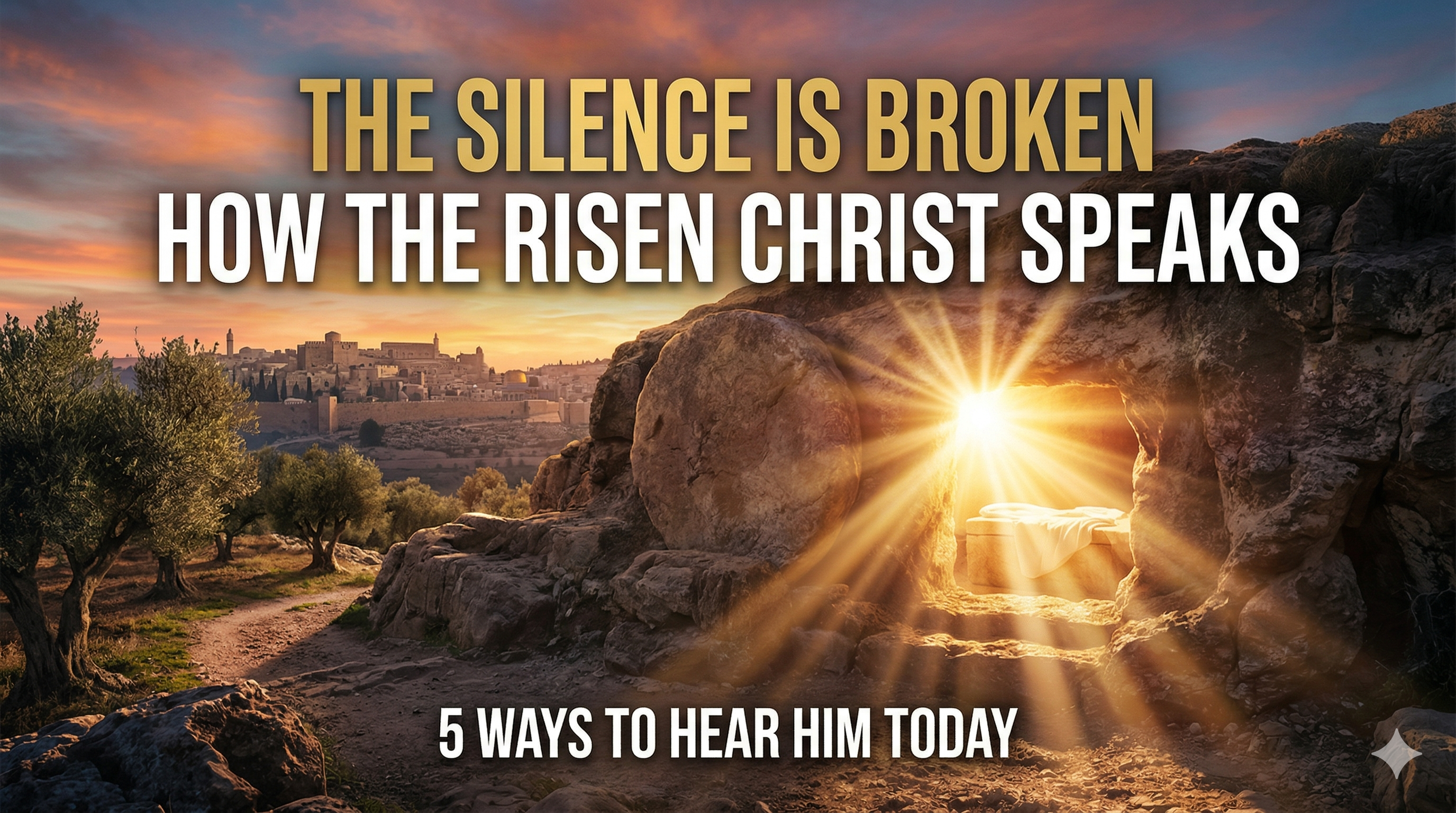
There is no week in the Christian calendar quite like Holy Week. In the span of just eight days, we walk with Jesus through the highest highs and lowest lows of human experience -- from the roaring hosannas of Palm Sunday to the crushing darkness of the cross, and finally to the breathtaking wonder of the empty tomb. It is a journey that, if we let it, can change us from the inside out. But only if we slow down long enough to truly enter into it.
The problem is that Easter often arrives before we are ready. The busyness of daily life crowds out the sacred rhythm of Holy Week, and we find ourselves standing in the pews on Resurrection Sunday morning without having walked the road that leads there. We celebrate the triumph without feeling the weight of the sacrifice. We sing of the risen Christ without having knelt at the foot of the cross. And so we miss the fullness of what Easter offers -- not just a theological truth to affirm, but a lived experience that reshapes our hearts.
This guide is an invitation to do things differently this year. Over the course of eight days -- from Palm Sunday through Resurrection Sunday -- you will meditate on the key scriptures of Holy Week, sitting with each passage long enough to hear what God is saying to you. Each day includes a focal scripture, a reflection to guide your thoughts, and a simple meditation exercise. Whether you set aside fifteen minutes each morning or find a quiet moment before bed, this practice will prepare your heart to receive the full wonder of Easter in a way that head knowledge alone never could.
Why Holy Week Matters
Holy Week is not simply a historical commemoration. It is the hinge on which all of human history turns. In these eight days, every major theme of Scripture -- creation and fall, promise and fulfillment, sin and grace, death and resurrection -- converges in the person of Jesus Christ. The God who spoke galaxies into existence walks willingly toward a Roman cross. The Lamb of God, slain before the foundation of the world, lays down His life so that you might live. This is the story that gives meaning to every other story, the event that makes sense of everything that came before and everything that has followed since.
When you walk through Holy Week with intention, something remarkable happens. The familiar narrative stops being a story you know and becomes a story you inhabit. You feel the dust of the Jerusalem road beneath your feet. You hear the crack of the whip. You sit in the devastating silence of Saturday. And when Sunday morning finally breaks, the joy you feel is not polite or predictable -- it is volcanic, erupting from the deepest place in your soul because you have tasted, even in a small way, what was at stake.
Meditating on Scripture during Holy Week also connects you to the global body of Christ across time and space. For two thousand years, believers have walked this same path, prayed over these same passages, and encountered the same risen Lord. When you join them, you participate in something far bigger than your individual devotional life. You become part of the great chorus of witnesses who testify that Jesus is alive -- and that His resurrection changes everything.
A Day-by-Day Holy Week Scripture Meditation Guide
Palm Sunday -- The Triumphal Entry
Holy Week begins with a parade unlike any the world has ever seen. The crowds lining the road into Jerusalem expected a conquering king -- a military hero who would overthrow Rome and restore Israel to its former glory. They spread their cloaks and waved palm branches, shouting "Hosanna," which means "Save us!" And Jesus did come to save them -- but not in the way they imagined. He rode not a war horse but a humble donkey, fulfilling Zechariah's ancient prophecy of a king who comes "gentle and riding on a donkey" (Zechariah 9:9).
As you meditate on this scene, consider the gap between what the crowds wanted and what Jesus came to offer. They wanted political liberation; He brought spiritual transformation. They wanted an earthly kingdom; He inaugurated an eternal one. How often do you approach God with your own agenda, asking Him to save you on your terms? Palm Sunday invites you to surrender your expectations and receive the King as He actually is -- humble, gentle, and far more powerful than any warrior on horseback.
Meditation exercise: Close your eyes and imagine yourself in the crowd along that dusty road. What are you hoping Jesus will do for you? Now watch as He approaches -- not on a stallion, but on a donkey. What does His humility stir in you? Speak honestly to Him about the gap between what you want and what He offers. Then listen for His response.
Monday -- Cleansing the Temple
On the day after His triumphal entry, Jesus entered the temple courts and found a marketplace where there should have been a house of prayer. Money changers exploited worshippers. Merchants turned sacred space into a den of thieves. And Jesus -- the gentle king on the donkey -- burned with holy anger.
This passage reveals a side of Jesus that can make us uncomfortable. We prefer the gentle shepherd, the friend of sinners, the healer of the brokenhearted. But Jesus is also the righteous judge who will not tolerate the corruption of what is holy. His anger was not petty or selfish -- it was the fierce love of a bridegroom defending the honor of His bride.
The New Testament teaches that you are now the temple of the Holy Spirit (1 Corinthians 6:19). What has crept into the sacred space of your heart that does not belong there? What distractions, idols, or compromises have turned your inner sanctuary into a marketplace? Monday's meditation is an invitation to let Jesus overturn the tables in your own life -- not to punish you, but to restore your heart to its true purpose: communion with God.
Meditation exercise: Ask the Holy Spirit to show you one area of your life where something other than God has taken the central place. It might be anxiety, ambition, a relationship, or an addiction. Picture Jesus entering that space with fierce tenderness. He is not angry at you -- He is angry at what is stealing your peace. Let Him clear the room. Then sit in the stillness of a heart restored to prayer.
Tuesday -- Teaching and Authority
Tuesday of Holy Week was a day of intense teaching. The religious leaders tried to trap Jesus with trick questions about taxes, resurrection, and the law. But Jesus answered each challenge with breathtaking wisdom, ultimately distilling the entire Old Testament into two commands: love God completely, and love your neighbor as yourself. In these two sentences, Jesus gave us the compass for all of life.
Notice the order. Loving God comes first -- not because your neighbor does not matter, but because you cannot truly love others until you are grounded in God's love for you. A heart that is full of God's love overflows naturally toward others. A heart that tries to love others without first being filled will eventually burn out, grow resentful, or become performative. Jesus is teaching you that your relationship with God is not one obligation among many -- it is the wellspring from which everything else flows.
Meditation exercise: Slowly repeat the two commandments three times. On the first reading, focus on the word "all" -- all your heart, all your soul, all your mind. What would it look like to hold nothing back from God? On the second reading, focus on "your neighbor." Bring to mind someone specific who needs your love this week. On the third reading, simply rest in the reality that before you could love God at all, He first loved you (1 John 4:19).
Wednesday -- Preparation and Betrayal
Wednesday is sometimes called "Spy Wednesday" because it is the day tradition tells us Judas Iscariot made his deal with the chief priests to betray Jesus. The contrast between devotion and betrayal could not be sharper.
In Matthew 26:6-13, a woman anoints Jesus with expensive perfume -- an act of extravagant worship that Jesus says will be remembered wherever the gospel is preached. And yet just a few verses later, we read the chilling words that set the Passion in motion:
Wednesday forces you to confront an uncomfortable truth: betrayal does not come from outside the circle. It comes from within. Judas was one of the Twelve. He walked with Jesus, ate with Him, watched Him heal the sick and raise the dead. And still, he traded it all for thirty pieces of silver. Before you judge him too harshly, consider the ways you trade intimacy with Christ for lesser things -- comfort, approval, control, security. Betrayal is not always dramatic. Sometimes it is simply the slow drift of a heart that stops paying attention.
Meditation exercise: Hold this question before the Lord in silence: "Where am I drifting?" Do not rush to answer. Let the Holy Spirit search your heart gently. If He brings something to mind, do not respond with shame -- respond with the woman's perfume. Pour out your honesty, your repentance, and your love at Jesus' feet. He receives it all.
Maundy Thursday -- The Last Supper
The word "Maundy" comes from the Latin word "mandatum," meaning "command" -- and it refers to this new commandment Jesus gave on the night before He died. But before He spoke these words, He did something that shocked everyone in the room. He got up from the table, wrapped a towel around His waist, and washed His disciples' feet.
In first-century Palestine, foot washing was the job of the lowest household servant. No rabbi, no teacher, no honored guest would ever stoop to such a task. And yet here was the Creator of the universe, kneeling on the floor with a basin of water, scrubbing the dirt from between His followers' toes -- including the feet of Judas, who would betray Him within hours, and Peter, who would deny Him before dawn.
This is the love Jesus commands you to practice. Not a sanitized, comfortable love that serves only when it is convenient, but a love that kneels in the dirt, that serves the undeserving, that gives without calculating the return. It is a love that can only flow from a heart that has first received it. You cannot wash feet unless you have first let Jesus wash yours.
After the foot washing, Jesus took bread, broke it, and said, "This is my body given for you; do this in remembrance of me" (Luke 22:19). Then He took the cup and said, "This cup is the new covenant in my blood, which is poured out for you" (Luke 22:20). In these simple elements -- bread and wine, body and blood -- Jesus gave His followers a way to remember His sacrifice until He returns. Every time you take communion, you proclaim that His death was real, His love was costly, and His promise is sure.
Meditation exercise: Picture Jesus kneeling before you with a towel and basin. He looks up at you with eyes full of love. He knows everything about you -- your failures, your fears, your secret shame -- and He kneels anyway. Let Him wash your feet. Then ask Him: "Whose feet are you calling me to wash this week?" Sit with His answer.
Good Friday -- The Crucifixion
There are no words adequate to the horror and the glory of Good Friday. On this day, the sinless Son of God was beaten, mocked, spat upon, stripped naked, and nailed to a Roman cross -- the most brutal form of execution ever devised. He hung there for six hours, suffocating under His own weight, while soldiers gambled for His clothes and passersby hurled insults at the dying Creator of the world.
But this was not a tragedy that spiraled out of control. This was the plan. From before the foundation of the world, the Father and the Son had agreed that love would go this far. Every lash of the whip, every thorn pressed into His brow, every nail driven through flesh and bone -- all of it was the deliberate, costly, unflinching love of God for you. The cross is not an accident. It is the clearest window into the heart of God that has ever existed.
Isaiah wrote those words seven hundred years before the cross, but they read like an eyewitness account. "Pierced for our transgressions" -- not His own, but yours and mine. "Crushed for our iniquities" -- the weight of every sin ever committed, past, present, and future, laid on the shoulders of the only One who never sinned. "The punishment that brought us peace was on him" -- your peace cost Him everything. "By his wounds we are healed" -- the very injuries that destroyed His body are the source of your wholeness.
Good Friday asks you to do something that every instinct in your body resists: to stay at the cross. Do not rush past it to get to Sunday. Do not look away from the blood and the agony and the darkness. Let it sink in that this is what your sin cost. Let it sink in that this is what God's love was willing to pay. The resurrection means nothing if the cross means nothing. The empty tomb is only glorious because the cross was so devastating.
When Jesus cried "It is finished," He was not expressing defeat. The Greek word is "tetelestai" -- a term used in commerce when a debt was paid in full. It was stamped on receipts to indicate that the balance owed was zero. In His final breath, Jesus declared that the debt of sin that separated you from God had been completely, irrevocably, permanently paid. There is nothing left to add. No amount of good works, religious performance, or self-punishment can improve upon what Christ accomplished on the cross. It is finished.
Meditation exercise: Find a quiet place where you will not be disturbed. Read Isaiah 53:1-12 slowly, all the way through. Then return to verse 5 and read it again, this time inserting your own name: "[Your name] was pierced for [your] transgressions, crushed for [your] iniquities; the punishment that brought [your] peace was on him, and by his wounds [you are] healed." Sit in silence for as long as you need. If tears come, let them. If words of gratitude rise up, speak them. If all you can do is whisper "thank you," that is enough.
Holy Saturday -- Waiting in the Tomb
Holy Saturday is the forgotten day of Holy Week. We rush from the drama of Friday to the celebration of Sunday and skip right over the day when nothing seemed to happen -- the day when God was silent, the tomb was sealed, and the disciples hid behind locked doors, paralyzed by grief and fear.
But Saturday is where most of us actually live. We live in the space between the promise and the fulfillment, between the prayer and the answer, between the loss and the restoration. We live in the already-but-not-yet, believing that God is good but unable to see the evidence. Saturday is the day of faith without sight, hope without proof, trust without understanding.
The disciples did not know that Sunday was coming. They had no script, no spoilers, no guarantee. They had only the memory of a man they loved hanging dead on a cross and the crushing weight of shattered expectations. Everything they believed had been buried in a borrowed tomb. If you have ever felt that God has abandoned you, that your prayers are hitting the ceiling, that the story of your life has taken a turn so dark that redemption seems impossible -- then you know Saturday.
And yet. Even in the tomb, even in the silence, even in the apparent defeat, God was working. The seed was in the ground. The stone had not yet rolled away, but the power of resurrection was already stirring in the darkness. Saturday teaches you that God's silence is not God's absence. The waiting is not wasted. The tomb is not the end of the story -- it is the place where the greatest miracle in history is being prepared.
Meditation exercise: What are you waiting for right now? What prayer feels unanswered? What hope feels buried? Bring it before the Lord and simply sit with Him in the silence of Saturday. Do not try to fix it or figure it out. Just be present with the One who is present with you, even when you cannot feel Him. Repeat Psalm 27:14 slowly until it becomes less a command and more a comfort: "Wait for the Lord; be strong and take heart and wait for the Lord."
Resurrection Sunday -- He Is Risen!
And then -- Sunday. The stone is rolled away, not to let Jesus out, but to let the world in to see that the tomb is empty. An angel sits where death once lay. The grave clothes are folded neatly -- a detail that speaks of calm, deliberate authority, not the chaos of a robbery. Jesus of Nazareth, who was dead, is alive. And nothing in heaven or on earth or under the earth will ever be the same again.
"He is not here; he has risen, just as he said." These ten words are the most important sentence in the history of the world. If they are true -- and they are -- then death is defeated, sin is forgiven, hope is restored, and the future is secure. If Jesus is risen, then every promise He ever made is trustworthy. If Jesus is risen, then the grave is not a wall but a door. If Jesus is risen, then the worst thing that ever happened -- the murder of the Son of God -- has been transformed into the best thing that could ever happen: the salvation of the world.
Notice who receives the news first. Not the religious leaders. Not the political powers. Not even the eleven remaining apostles. The first witnesses of the resurrection are women -- Mary Magdalene and the other Mary -- who came to the tomb with nothing but grief and spices for anointing the dead. They came expecting to care for a corpse, and instead they met the living God. That is how Easter works. It meets you in your grief, in your hopelessness, in the place where you have given up, and it speaks the word that changes everything: "He is risen."
The resurrection is not merely something that happened two thousand years ago. It is a living reality that reshapes every moment of your life today. Because Jesus rose, you are no longer defined by your worst failures. Because Jesus rose, death has lost its sting and the grave has lost its victory (1 Corinthians 15:55). Because Jesus rose, you have a hope that is anchored not in your own strength or goodness but in the unbreakable power of God. The same power that raised Christ from the dead is alive in you right now (Ephesians 1:19-20). Let that truth settle deep into your bones this Easter.
Meditation exercise: Stand up, if you are able. Read Matthew 28:5-6 aloud. Then say these words aloud: "He is risen. He is risen indeed." Say them again, louder this time. Let the declaration move from your lips to your mind to your heart to your bones. Think of one area of your life that feels dead -- a dream, a relationship, a part of your faith that has gone cold. Hold it up to the risen Christ and ask Him to breathe resurrection life into it. Then worship. Sing, pray, shout, weep with joy -- however your heart needs to respond to the God who conquered the grave.
How to Meditate Through Holy Week
Walking through Holy Week with Scripture is not complicated, but it does require intentionality. Here are five practical tips to help you get the most out of this journey:
1. Set aside a consistent time each day. Whether it is fifteen minutes in the morning before the house wakes up or a quiet moment after the children are in bed, choose a time and protect it. Holy Week is only eight days long -- you can do almost anything for eight days. Put it on your calendar, set an alarm, and treat it as an appointment with the King of Kings.
2. Read slowly and read aloud. Scripture meditation is not speed reading. Read each day's passage at least twice -- once to understand the content and once to listen for what God is saying to you personally. Reading aloud engages more of your senses and helps the words sink deeper. Let the syllables of Scripture fill the room and fill your heart.
3. Engage your imagination. The Bible is not a textbook -- it is a story, and you are invited to enter into it. Picture the scenes. Hear the sounds. Feel the emotions. Imagine yourself standing in the crowd on Palm Sunday, sitting at the table on Thursday, standing at the foot of the cross on Friday. Holy imagination is not making things up -- it is letting the truth of Scripture become vivid and personal.
4. Journal your reflections. After each day's meditation, take a few minutes to write down what struck you, what questions arose, and what you sensed God saying. You do not need to write beautifully or at length -- even a sentence or two creates a record of your journey that you can return to in future years. Over time, your Holy Week journal becomes a testimony of God's faithfulness in meeting you year after year.
5. Use guided meditations to go deeper. Sometimes the hardest part of meditation is knowing how to begin. The Faith: Scripture Meditation app offers guided sessions designed to help you engage with Scripture at a deeper level -- including meditations perfect for the Easter season. Let the app guide your breathing, focus your thoughts, and create space for the Holy Spirit to speak.
"I want to know Christ -- yes, to know the power of his resurrection and participation in his sufferings, becoming like him in his death, and so, somehow, attaining to the resurrection from the dead." -- Philippians 3:10-11 (NIV)
Conclusion
Holy Week is not a spectator event. It is an invitation to walk the road with Jesus -- to wave the palms, kneel in the upper room, stand at the cross, wait in the silence, and emerge into the blinding light of Resurrection morning. When you engage with these scriptures through meditation rather than merely reading them for information, they move from the page into your heart, from ancient history into present reality, from someone else's story into yours.
This Easter, do not settle for a secondhand experience of the resurrection. Prepare your heart. Walk the road. Feel the weight. And when Sunday comes -- when the angel says those words that have echoed through twenty centuries -- you will hear them not as a familiar refrain but as a personal declaration spoken directly to you: "Do not be afraid. He is not here. He has risen, just as he said."
May this Holy Week be the one that changes everything. May the scriptures you meditate on take root so deeply that they bear fruit for years to come. And may the risen Christ meet you in every passage, every reflection, and every moment of stillness -- reminding you that because He lives, you too will live.